

Ancient Finnish Forest Tales
old beliefs about nature’s hidden beings

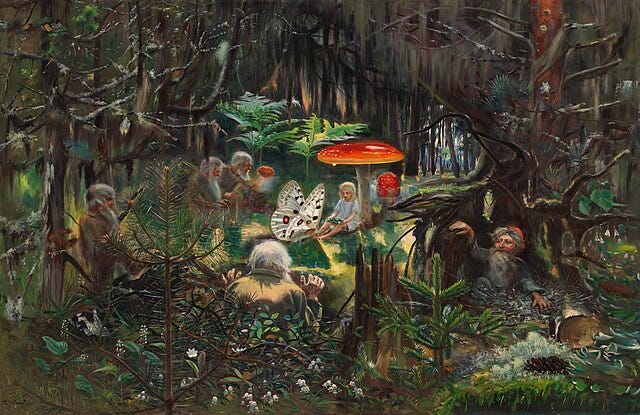
Finland’s forests, hills, fells, and waters are home to many mysterious beings. For thousands of years, various spirits, elves, giants, mountain trolls, goblins, and water demons have wandered through Finnish folklore. Long ago, at a time when even the stones were soft beneath the feet of wanderers, these beings moved through the land, shaping stories and imagination alike.
They arose from people’s need to explain natural phenomena, warn of dangers, and understand the events of their surroundings. I’m sharing a glimpse of some old mystical lore and forgotten tales.
If you enjoy this post and want to read more like it in the future, I hope you’ll hit the “like” button before you go. Now, let’s dig in to Finnish mythology!


Näkki
When you see water splashing, bubbling, or foaming, it is usually the work of the Näkki. It is a freshwater spirit whose favorite pastime is tricking people into the water. It can lurk in the shade of lily pads, waiting for a swimmer’s foot to get caught in the submerged stems.
Sometimes it can be seen on a rock, combing its long hair. The Näkki was believed to be able to change its shape, for example into a stone or a log. To protect children going swimming, the words “Näkki to the land, I to the water” were said before entering the water. Talking about the Näkki was meant to make children cautious around water.
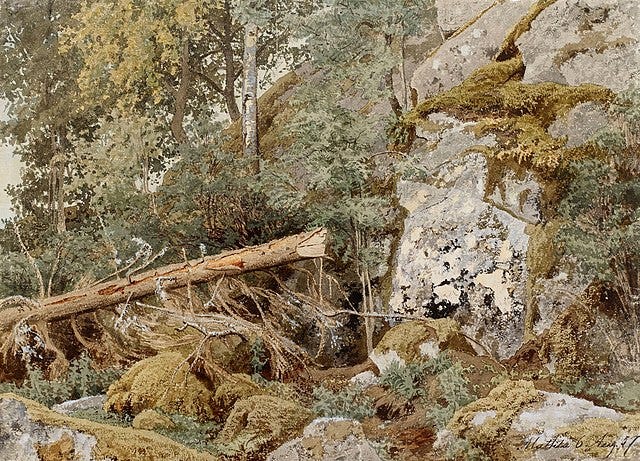
Metsänpeitto - forest’s cover
Metsänpeitto, forest’s cover is a state that a person can end up in while walking in the forest. It is believed to be caused by an earth elf.
Those who fall under forest’s cover feel strange and unfamiliar. The forest falls silent, birdsong fades away. The once-familiar forest becomes odd, upside-down, or bizarre.
Other people can no longer see the person — they may become invisible, or appear as a stump or a rock to others, even though the person themselves feels unchanged.
Some manage to escape forest’s cover through tricks or by chance, but some never return.

Becoming a bear
Long ago, it was believed that humans were descended from bears. Bears were respected, and they were thought to be able to read human thoughts and understand human speech. Many similarities were seen between humans and bears: a bear’s paw like a human hand, a bear’s snout like a human face, and bears were also capable of walking on two legs.
Some people in the North were also believed to be able to transform into a bear. They would go into the forest, find a suitable tree leaning toward the north, and then crawl three times under it. Finally, they would emerge as a bear.

Tapio, King of the Forest
Tapio is an ancient Finnish forest god, ruler of animals and hunting. People honored him with offerings, like the first catch of a hunt, to ensure good fortune and share in the forest’s resources. His beard is made of moss, and he has horns on his head. According to some stories, Tapio’s beard was made of wood, and his eyes were like two bottomless lakes.
Tree stumps have been called “Tapio’s tables,” and offerings have been left on them. Mielikki, Tapio’s wife, is the gentle goddess of the forest. She protects animals and plants, oversees the forest’s resources, and is skilled in healing with herbs and natural remedies.
Hiisi
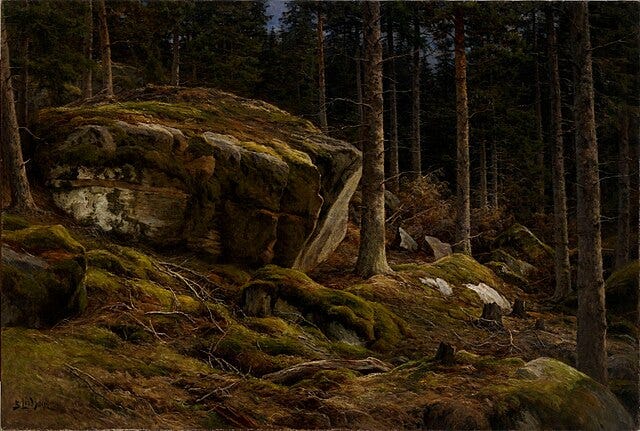
The most terrifying being among the mountain folk is Hiisi. Hiisi dwells in its fortress, deep within the darkest crevices of the mountain. Its head is an ice boulder or a rock, and its mouth gapes like a kettlehole. Its beard is frosty, and its breath is freezing.
The mountain inhabited by Hiisi can be recognized by a weeping rock — a cliff that is always wet, where a stone has split in a cross shape. On the northern slope, which is always in shadow, the mouth of a cave may be found. Step inside… if you dare.
Do you have an old tale or folk story that has left an impression on you? Share it in the comments! ✨

Such a wondrous and nostalgic story! There is so much correlation with Northern Russian mythology - we have very similar forest creatures. And the bear painting! - many a household had this painting hanging on a wall somewhere! Did you know that the bears were painted by a different painter - Shishkin only painted landscapes. They originally put both their signatures on the work, but one of them was removed by the commissioner of the painting.
Mä oon ollut kerran metsänpeitossa lapsena, mut onneksi mun mummi oli kertonut tästä jo aiemmin mulle ja osasin tehdä ”oikeat jutut”, jotta pääsin sieltä pois. Mummi tiesi muutenkin paljon tällaisista jutuista.